A MotoGP calendar is normally read in a very simple way.
Dates.
Circuits.
Countries.
Travel.
Logistics.
But viewed through a sponsorship lens, it becomes something completely different.
It becomes a map of commercial opportunities.
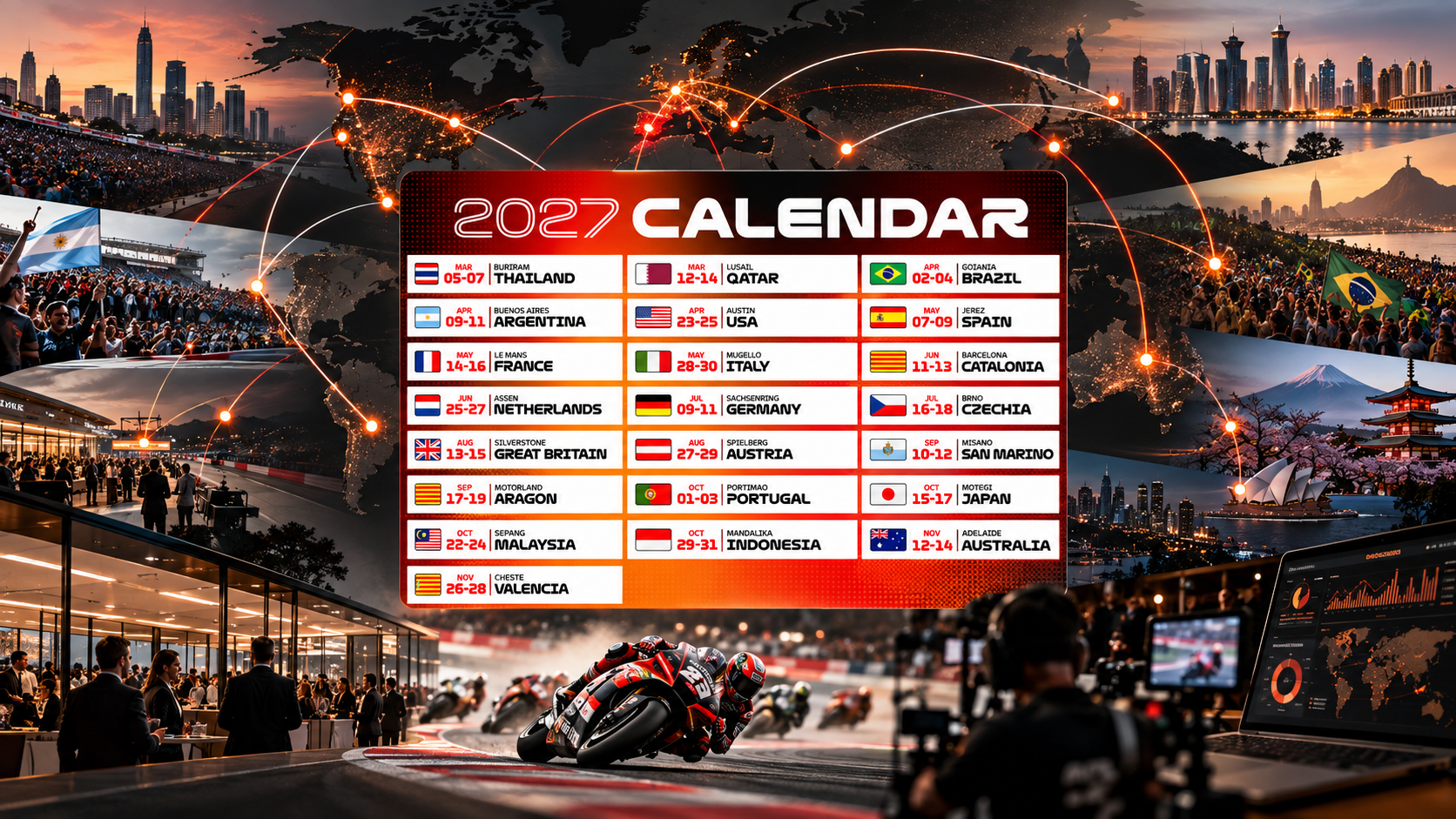
MotoGP’s international footprint stretches across Europe, Asia, the Middle East, Oceania and the Americas. Thailand has already been confirmed as the opening round of the new 2027 era, while Valencia will close the season. MotoGP is also taking its 2027 Season Launch to Rio de Janeiro, demonstrating how individual markets can become strategic assets beyond the race itself.
For brands, however, simply appearing across a global calendar is not enough.
The real question is:
What can a sponsor actually do with that geography?
Global Reach Is Only the Starting Point
Global scale remains one of MotoGP’s obvious attractions.
MotoGP reported that its global fanbase reached 632 million in 2025, alongside more than 60 million digital followersand a record 3.6 million spectators attending race weekends. Average television audiences also grew compared with the previous season.
Those numbers demonstrate the potential scale of the property.
But they need to be interpreted carefully when building a sponsorship proposition.
A championship’s declared global fanbase is not automatically equivalent to the audience an individual sponsor can effectively reach.
Nor does racing in a country automatically create commercial value for every partner.
A logo can receive international exposure without generating the same relevance in every market.
And a total audience figure cannot tell a sponsor, by itself, how many people noticed its activation, remembered the brand or changed behaviour because of it.
The calendar provides potential.
Strategy determines how much of that potential becomes measurable value.
Twenty Plus Markets Should Not Mean One Story Repeated Twenty Plus Times
One of the most interesting characteristics of MotoGP is its geographical diversity.
Every race takes the championship into a different commercial and cultural environment.
Different consumers.
Different lifestyles.
Different media habits.
Different levels of motorcycle penetration.
Different business objectives.
Different brand associations.
This creates an important opportunity.
A sponsor can maintain one global strategic idea without reproducing exactly the same activation everywhere.
Global consistency does not require local uniformity.
Imagine a multinational partner building a season long MotoGP platform.
In Italy, the narrative could naturally connect with engineering, craftsmanship, design and heritage.
Japan may allow the same partnership to emphasise technology, precision or innovation.
Southeast Asian markets offer a completely different context, where motorcycles often play a much more visible role in everyday life and where community may become a particularly relevant territory.
Brazil can combine motorsport passion, entertainment and culture. The returning Brazilian GP attracted almost 150,000 spectators in 2026, while Rio de Janeiro will host the 2027 Season Launch on Botafogo Beach.
The United States may offer opportunities around lifestyle, entertainment, technology and corporate development.
The central partnership remains recognisable.
Its expression changes.
That is much more powerful than simply exporting the same campaign from one circuit to another.
Geography Should Influence the Pitch
This should also change the way sponsorship proposals are constructed.
Selling MotoGP as:
“A global championship racing across multiple continents”
is factually useful.
Commercially, however, it only begins the conversation.
A stronger proposal asks:
Where does the prospective sponsor operate?
Which countries are strategic growth markets?
Where does it already have significant market share?
Where is it launching new products?
Where are its key distributors?
Which races could be particularly valuable for corporate hospitality?
Which markets offer consumer activation opportunities?
Which races could support relationships with employees, dealers or clients?
The calendar then becomes part of the commercial strategy rather than simply a slide in the deck.
Different partners will value the same race differently.
For one company, a Grand Prix may primarily be a brand awareness opportunity.
For another, it may be a B2B platform.
For another, hospitality may be the priority.
For a consumer brand, fan activation may matter most.
For a technology company, the paddock itself might provide the most interesting environment for demonstrating expertise and building business relationships.
The value of geography therefore depends on the objective.
The Race Can Become a Content Brief
There is another dimension that I believe deserves much more attention.
Content.
If MotoGP travels through different cultures throughout the season, that should provide an enormous source of storytelling material for partners.
Not every Grand Prix needs the same content template.
A market contains much more than a circuit.
Food.
Music.
Design.
Cities.
Technology.
Local motorcycle culture.
Fans.
Personalities.
Communities.
A sponsor can use these ingredients to create different chapters of the same overall story.
The race provides the trigger.
The market provides the context.
The brand provides the perspective.
This is especially important as sponsorship value increasingly extends beyond live television exposure.
A locally relevant piece of content may continue circulating long after the motorcycle has left the circuit.
That creates a different way of thinking about calendar value.
Sponsorship Should Not Be Valued Only on Race Sundays
A MotoGP partnership should also not be judged solely on the number of race weekends.
The calendar creates major peaks of attention.
But the real opportunity is to build value between those peaks.
Documentary series.
Technical storytelling.
Rider content.
Factory access.
Behind the scenes material.
Hospitality.
Customer programmes.
Employee engagement.
Paddock experiences.
Partner events.
Digital campaigns.
A partnership can create a continuous narrative throughout the season.
That means sponsorship potentially becomes much more than exposure during a series of Sundays.
It becomes a year round ecosystem.
This is also where team identity becomes commercially important.
A team with a strong identity has more to talk about when the racing stops.
Its history.
Its people.
Its technology.
Its culture.
Its values.
Its riders.
Its geographical roots.
The stronger that ecosystem becomes, the less the partnership depends exclusively on sporting results to generate attention.
Storytelling Does Not Replace ROI
There is a lot of attention today around storytelling in sponsorship.
Correctly so.
The days of simply placing a logo on a fairing and expecting that alone to justify the investment are disappearing.
But storytelling should not become an excuse to ignore measurement.
Numbers remain fundamental.
Reach.
Frequency.
Engagement.
Brand recall.
Hospitality usage.
Leads generated.
Customer acquisition.
Employee participation.
Sales impact where attribution is realistically possible.
A good sponsorship proposal should therefore answer two different questions.
Why should people care about this story?
And:
How will we know whether it worked?
Neither is enough by itself.
Data without meaning risks reducing sponsorship to media buying.
Storytelling without evidence risks turning strategy into creativity without accountability.
The strongest partnerships combine both.
From Geography to Measurable Value
This is why I increasingly see the MotoGP calendar as a strategic asset rather than simply a sporting schedule.
Every destination can simultaneously become:
a media market,
a consumer market,
a hospitality platform,
a B2B opportunity,
a content location,
a cultural touchpoint,
and a commercial development environment.
The challenge is connecting those elements.
Instead of:
Race → Visibility
the commercial logic becomes:
Market → Relevance → Activation → Content → Measurement
That is a significantly more sophisticated use of a global championship.
A Global Championship Does Not Need a Globalised Story
There is an interesting contradiction in international sponsorship.
Brands want global consistency.
But consumers increasingly expect relevance.
Those two objectives do not have to conflict.
A strong partnership needs a central idea that remains recognisable wherever MotoGP races.
But it also needs enough flexibility to interact naturally with different cultures.
That is where identity becomes essential.
A strong identity establishes what should remain constant.
Local strategy determines what can change.
Without identity, localisation risks fragmenting the partnership.
Without localisation, global consistency can become generic.
The strongest approach sits between those extremes.
The Calendar Is the Map, Not the Strategy
MotoGP’s international calendar is one of the championship’s most obvious commercial assets.
But geography alone does not create ROI.
A country on a calendar is an opportunity.
A market strategy turns that opportunity into relevance.
Activation turns relevance into interaction.
Content extends that interaction.
Measurement determines whether it created value.
That should increasingly influence how sponsorship properties are pitched.
Rather than simply telling prospective partners how many countries MotoGP visits, the stronger conversation is about why particular countries matter to that particular business.
That is where the commercial story becomes specific.
And specific stories are much easier to activate, measure and defend.
The calendar tells us where MotoGP races.
A sponsorship strategy should explain why each of those places matters.
And perhaps that is the most useful way to read a global motorsport calendar.
Not as twenty plus destinations.
But as twenty plus opportunities to make the same partnership relevant in a different way.