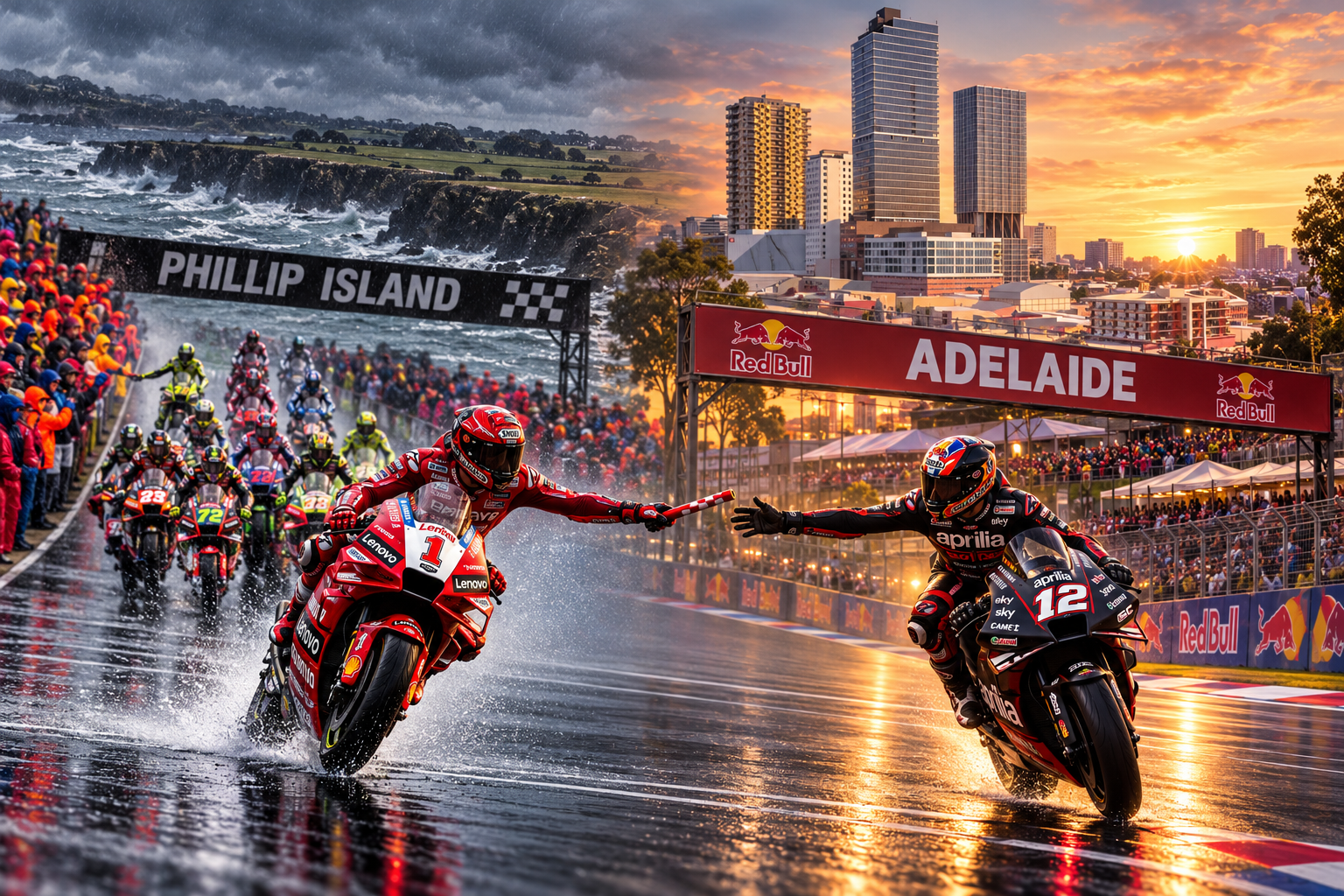
Phillip Island was supposed to say goodbye to MotoGP with one final race.
Instead, the final Sunday ended without one.
Poor visibility prevented the medical helicopter from operating safely, forcing the cancellation of the MotoGP, Moto2 and Moto3 races. Riders eventually completed farewell laps behind the safety car before stopping on the main straight to thank the fans.
It was not the ending anyone wanted.
And working inside the paddock, one thing became particularly clear to me during that final weekend.
Phillip Island will be missed.
Not only because of its racing history, but because very few circuits have such a strong visual identity.
The ocean.
The landscape.
The fast, flowing layout.
The feeling of arriving somewhere that looks completely different from almost every other venue on the calendar.
MotoGP itself described Phillip Island as one of those rare sporting venues that becomes part of a championship’s identity, highlighting both the racing and one of the most spectacular backdrops in motorsport.
That emotional connection matters.
But sport does not stand still.
And from 2027, MotoGP’s Australian chapter moves somewhere very different.
Adelaide.
A Different Kind of Australian Grand Prix
The contrast could hardly be greater.
Phillip Island represents nature, isolation, heritage and one of the most recognisable landscapes in motorcycle racing.
Adelaide represents the city.
Urban activation.
Hospitality.
Entertainment.
Corporate access.
Tourism.
And potentially a very different commercial model.
From 2027, the Australian Grand Prix will move to a new 4.13-kilometre, 15-corner circuit in Adelaide, creating the first city-centre MotoGP event of the modern era. The agreement runs for six years, through 2032.
The South Australian project is also being designed as much more than a piece of racetrack.
The city itself becomes part of the event.
Fan zones.
Premium hospitality.
Entertainment.
City-wide activations.
Tourism.
Corporate experiences.
All can exist much closer to the racing product than at a traditional permanent circuit.
That does not automatically make Adelaide better than Phillip Island.
It makes it commercially different.
And that difference is important.
The Commercial Interest Is Already Visible
Over the last few months, through my own work, I have been involved in conversations and projects connected to the new Adelaide event.
What has struck me is the level of commercial interest already surrounding a Grand Prix that has not yet taken place.
That is obviously anecdotal rather than a measure of future success.
But it is still significant.
When companies start exploring opportunities around an event before the first motorcycle has even raced there, it suggests that the venue itself is beginning to generate commercial curiosity.
And there are concrete reasons for that.
South Australia expects MotoGP and Supercars together to generate more than A$200 million in annual economic return, with the broader six-year programme projected to create more than A$1.2 billion in economic impact. Authorities also point out that more than 70% of Phillip Island attendees currently travel from outside Victoria, illustrating the tourism value already attached to the Australian GP.
Adelaide therefore is not simply inheriting a race.
It is attempting to turn the race into a city-wide event platform.
That creates new inventory.
New hospitality opportunities.
New content.
New activation spaces.
New B2B opportunities.
And potentially new reasons for non-endemic brands to become involved.
Then Red Bull Arrived
One announcement, in particular, caught my attention.
Red Bull will become title sponsor of the Australian Grand Prix in Adelaide for its inaugural 2027 edition and continue in 2028.
The partnership is specifically designed to include extensive city-wide activation, entertainment and fan experiences around race week.
Red Bull also took title sponsorship of the final Australian Grand Prix at Phillip Island in 2026, effectively placing the brand on both sides of the transition from one era to another.
That feels significant.
Not because a Red Bull title sponsorship in motorsport is unusual.
It clearly is not.
But because attaching one of the world’s most recognisable sports marketing brands to a completely new venue gives the project immediate commercial credibility.
Red Bull is not simply buying visibility around a race.
Adelaide gives the brand the possibility to activate across an entire city.
Entertainment.
Action sports.
Content.
Fan experiences.
Hospitality.
Lifestyle.
All of those territories fit naturally with Red Bull’s identity.
This is where the location itself starts becoming part of the sponsorship proposition.
Red Bull and Honda: Another Interesting Signal
There is another Red Bull development that I think belongs in the same conversation.
From 2027, Red Bull will also reunite with Honda HRC as one of the factory MotoGP team’s major partners under a multi-year agreement.
This revives a relationship that began in 2015 and was associated with some of Honda’s most successful years, producing 45 wins and more than 90 podiums together.
This is where the commercial story becomes particularly interesting.
Red Bull never disappeared from MotoGP as a championship.
It remained deeply involved through riders, teams, Grands Prix and other properties.
But its renewed presence around Honda and the Australian GP demonstrates something broader.
Major brands can recalibrate their involvement.
They can leave a team.
Reduce exposure.
Move budgets.
Prioritise different properties.
And then return when the commercial environment becomes attractive again.
That is normal business.
Sponsorship should not be interpreted as a permanent emotional commitment.
It has to answer corporate objectives.
Reach.
Markets.
Audience.
Brand positioning.
Business opportunities.
Content.
Hospitality.
KPIs.
ROI.
When those elements change, sponsorship strategies can change with them.
And when the proposition becomes attractive again, previous relationships can become relevant again too.
Nostalgia Has Value, But It Cannot Be the Business Case
This is also where nostalgia becomes interesting.
Fans remember Red Bull and Honda together.
They remember the successful years.
They remember riders, liveries, wins and championships.
That creates emotional equity.
But nostalgia alone does not justify a multi-year commercial investment.
A company of Red Bull’s scale still needs contemporary reasons to return.
The numbers need to work.
The audience needs to matter.
The property has to offer relevant activation possibilities.
The markets need to fit.
The championship needs to provide the right platform.
When those business fundamentals exist, nostalgia can become an additional layer.
And that combination can be extremely powerful.
The commercial proposition provides the rationale.
The history provides the emotion.
A returning partnership therefore does not have to recreate the past.
It can use the past to give the new relationship immediate meaning.
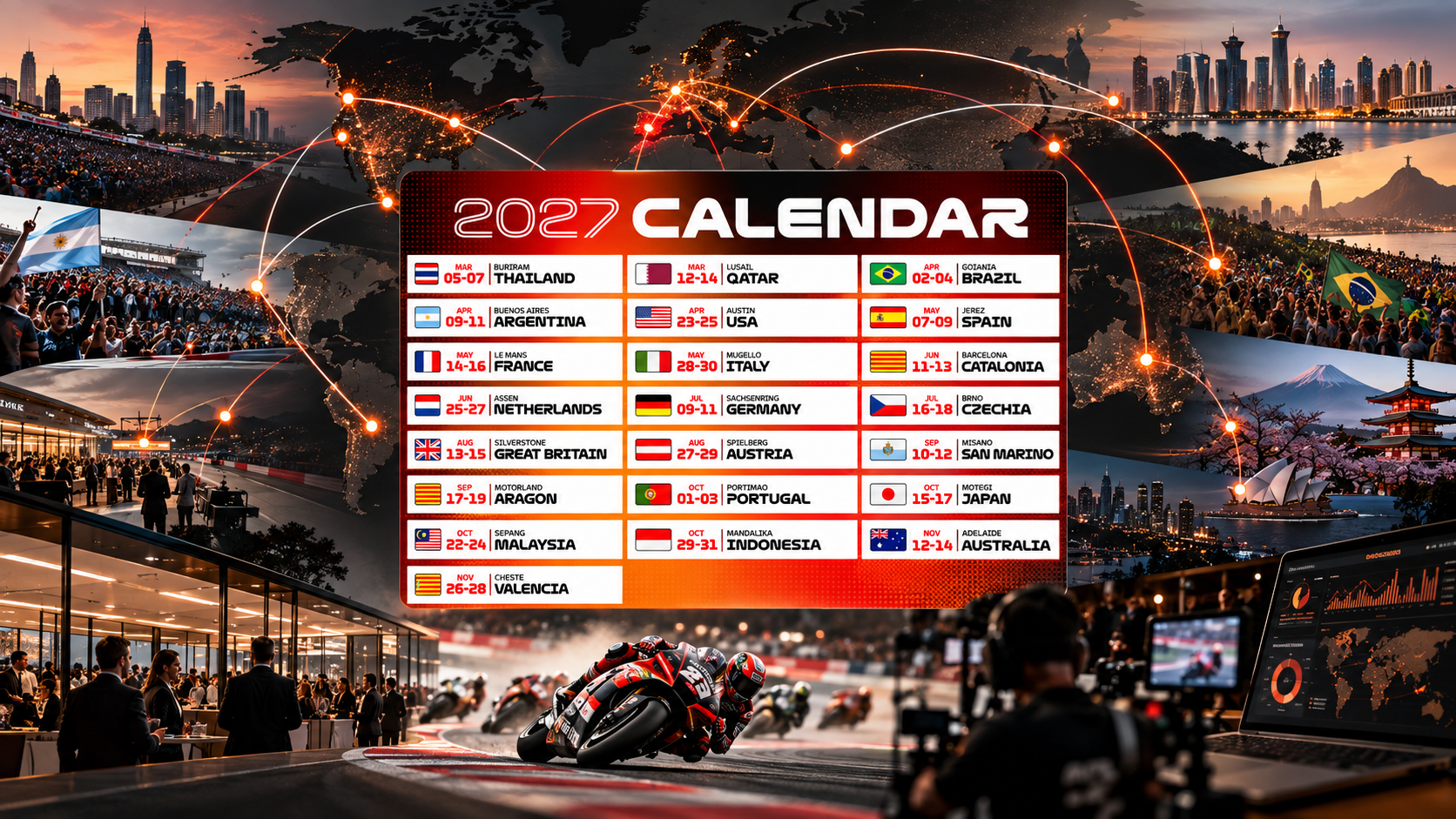
The New Commercial Geography of MotoGP
This also connects with another topic I have been exploring recently on The Sponsorship Apex.
Geography.
A calendar should not be read simply as a list of countries.
Every destination creates a different commercial environment.
Different consumers.
Different tourism opportunities.
Different partners.
Different local industries.
Different content possibilities.
Adelaide is a particularly clear example.
MotoGP is not moving from one Australian circuit to another similar Australian circuit.
It is moving from an island venue with extraordinary sporting heritage to a city-centre event designed explicitly around tourism, entertainment and economic activation.
That creates a different commercial canvas.
The race remains the centre.
But much more can happen around it.
This is particularly relevant as MotoGP evolves under its broader sports entertainment strategy.
The championship needs events that can create value before Friday morning and after Sunday afternoon.
Adelaide appears designed with that objective in mind.
A Venue Can Become an EGE
This also connects naturally with my concept of EGE:
Event Generated by the Event.
A sporting event creates value when it generates other commercial and cultural experiences around itself.
Fan zones.
Concerts.
Brand activations.
Corporate events.
Hospitality.
Action sports.
Content.
City experiences.
MotoGP is the original event.
But the commercial opportunity becomes much larger than the race.
Adelaide may offer one of the clearest demonstrations of that model.
The city does not simply host MotoGP.
MotoGP can generate an entire ecosystem inside the city.
That distinction matters.
Because the more inventory a Grand Prix can create outside the racetrack itself, the more ways brands have to participate.
And that potentially makes the property attractive to companies that may not have considered traditional motorsport sponsorship.
New Markets Do Not Mean Abandoning Old Identity
There is a delicate balance here.
Phillip Island had identity.
A lot of it.
Replacing an iconic circuit with a commercially ambitious urban event inevitably creates questions about what MotoGP gains and what it loses.
Those questions are legitimate.
Commercial evolution should not automatically mean erasing heritage.
In fact, MotoGP’s own farewell acknowledged that Adelaide must build on the foundations created at Phillip Island rather than pretend they never existed.
That is important.
Adelaide will need to create its own identity.
Not imitate Phillip Island.
And not try to replace decades of history overnight.
Its strength will probably come precisely from being different.
Phillip Island was spectacular because of where it was.
Adelaide can become spectacular because of what can happen around it.
Sponsors Can Come Back When the Proposition Changes
For me, Red Bull is one of the most interesting elements in this transition.
Not because its involvement proves that Adelaide will succeed.
One sponsor cannot prove that.
But it is a meaningful market signal.
A global brand is committing its name to the new Australian GP and simultaneously rebuilding a major relationship with one of MotoGP’s most historic factory teams.
That suggests confidence not simply in a race, but in where the championship may be heading.
And it reinforces a broader lesson about sponsorship.
Brands do not necessarily disappear forever when a relationship ends.
A sponsor can leave today and return years later if the environment changes.
If the championship grows.
If the audience evolves.
If new markets become strategically relevant.
If the commercial rights become more valuable.
If activation possibilities improve.
If the property once again fits the KPIs the company needs to achieve.
This is why retaining relationships and brand history matters even after a sponsorship ends.
The next deal may not always come from a new company.
Sometimes it comes from an old partner seeing a new opportunity.
Goodbye to One Identity, the Beginning of Another
Phillip Island deserved a better final Sunday.
For many people inside the paddock, myself included, its absence will be felt.
There are places that become much more than another stop on the calendar.
Phillip Island was one of them.
But the transition to Adelaide also illustrates what the next phase of MotoGP may increasingly look like.
Historic racing heritage combined with new commercial thinking.
Traditional fans combined with new audiences.
Racing combined with city-wide entertainment.
Nostalgia combined with measurable business value.
And established partners discovering new reasons to invest.
Perhaps that is the most interesting part of this transition.
MotoGP is not simply moving the Australian Grand Prix.
It is changing what an Australian Grand Prix can commercially become.
Phillip Island showed how strongly a circuit can become part of the identity of a championship.
Adelaide now has to prove something different.
That a new venue can become part of its commercial future.
And the fact that brands such as Red Bull are already positioning themselves around that future is worth paying attention to.
Phillip Island leaves MotoGP with memories.
Adelaide begins with opportunity.
The challenge will be turning that opportunity into an identity strong enough to create its own memories.