What happens when a championship takes more than 70 years of history out of the paddock and places it in front of fans, manufacturers, technology companies, media and the wider motorcycle industry?
It stops being just history.
It becomes a commercial and cultural asset.
That is why I find MotoGP’s upcoming presence at EICMA particularly interesting.
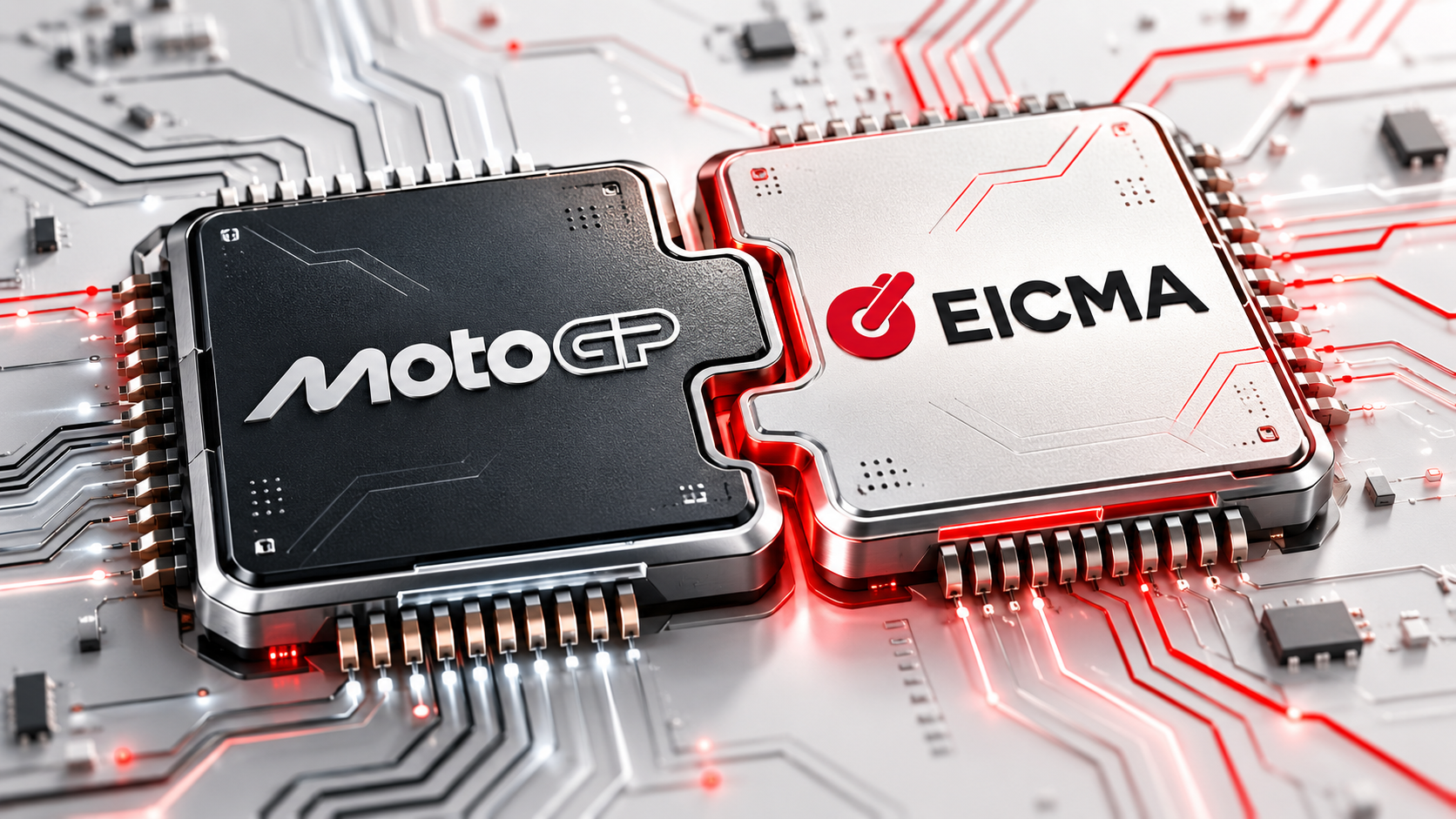
Through the new EICMA.SHIFT UP alliance, Legends of Speed will bring together more than 70 years of premier-class racing in Milan, with over 35 motorcycles displayed across approximately 1,400 square metres alongside archive material, audiovisual content and interactive experiences.
It would be easy to describe this simply as a celebration of MotoGP’s past.
I believe it says much more about its future.
The Archive Can Become an Asset
Heritage is often treated passively.
Old motorcycles are preserved.
Historic photographs are displayed.
Championship anniversaries are celebrated.
Fans feel nostalgic.
There is nothing wrong with that.
But commercially, heritage becomes much more interesting when it helps explain the identity of the current product.
The motorcycles inside Legends of Speed tell precisely that story.
From the early years of the 500cc World Championship through MV Agusta, Honda, Yamaha, Suzuki, Ducati and some of the most extraordinary engineering experiments in motorcycle racing, to the machines competing today.
Each one represents a different period.
A different technological challenge.
A different interpretation of speed.
A different relationship between rider and machine.
Put together, they create more than a timeline.
They explain why MotoGP looks, feels and behaves the way it does today.
That is where heritage stops being nostalgia and starts becoming brand architecture.
“Wired Different” Needs Something to Be Different From
This also connects extremely well with MotoGP’s current Wired Different positioning.
The campaign is fundamentally about distinction.
MotoGP is intense.
Physical.
Unpredictable.
Technological.
Human.
Danger feels visible.
The rider’s body is part of the performance.
The machine moves underneath them.
The personality of the competitors is exposed in a way that gives motorcycle racing its own cultural language.
But identity becomes more credible when it has history behind it.
It is easy for a brand to declare that it is different.
It is much stronger when it can demonstrate why.
This is where Legends of Speed becomes strategically useful.
The current MotoGP machine is not presented in isolation.
It becomes the latest chapter of an evolution spanning generations of engineers, manufacturers and riders.
The history validates the positioning.
If Wired Different explains what MotoGP wants to represent today, Legends of Speed helps explain where that difference came from.
Heritage Alone Would Not Be Enough
The initiative becomes even more interesting because the experience does not stop with historic motorcycles.
MotoGP will also use EICMA for fan activities, interactive experiences, digital engagement and gaming, including opportunities linked to future MotoGP events.
That combination matters.
Because simply putting motorcycles behind barriers would create a museum.
Adding interaction creates an experience.
The visitor can move from observing MotoGP’s history to participating in its current ecosystem.
See.
Discover.
Interact.
Play.
Engage.
Potentially enter the Grand Prix environment itself.
That journey is much closer to contemporary sports marketing.
Heritage becomes the entry point.
Engagement becomes the mechanism.
MotoGP becomes the destination.
Why EICMA Matters Commercially
There is another part of the story that I think is even more important.
The location.
EICMA is not just a large public motorcycle exhibition.
It is one of the major gathering points of the global two-wheel industry.
Its previous edition brought together hundreds of exhibitors, more than 2,000 brands, tens of thousands of industry professionals, thousands of media representatives and creators, and hundreds of thousands of visitors.
That puts MotoGP in front of a particularly valuable audience.
Manufacturers.
Suppliers.
Technology companies.
Mobility businesses.
Media.
Distributors.
Potential partners.
Decision-makers.
Fans.
All in the same environment.
This means MotoGP’s presence communicates something beyond fan engagement.
It communicates positioning.
MotoGP has always been deeply connected with the motorcycle industry because manufacturers compete in the championship.
But there is a difference between being the racing series in which the industry participates and positioning yourself as the global cultural and entertainment platform around that industry.
The second proposition is commercially much broader.
From Racing Championship to Motorcycle Ecosystem
This is potentially where the opportunity becomes particularly interesting.
MotoGP does not have to restrict its commercial relevance to the companies that directly manufacture motorcycles or racing components.
Its territory can include:
technology,
gaming,
design,
fashion,
mobility,
media,
travel,
music,
lifestyle,
data,
content,
and entertainment.
The motorcycle remains the centre.
But an ecosystem develops around it.
That matters particularly as MotoGP looks for opportunities with more non-endemic partners.
A company does not necessarily need to have a direct relationship with motorcycle racing to understand the commercial value of technology, innovation, highly engaged communities and distinctive cultural identities.
EICMA gives MotoGP an unusually credible environment in which to make that argument.
EICMA.SHIFT UP and the EGE Concept
The initiative also connects very closely with an idea I have previously explored on The Sponsorship Apex:
EGE, Event Generated by the Event.
The starting point of EGE is that the commercial value generated by a sporting event does not need to remain within the physical or temporal boundaries of that event.
A Grand Prix can generate something else.
A fan festival.
A watch party.
A city activation.
A sponsor event.
A content series.
A cultural experience.
Each creates additional inventory around the original sporting property.
EICMA.SHIFT UP presents an interesting variation of that model.
MotoGP is not simply taking a Grand Prix and extending it outside the circuit.
Instead, it is taking the identity created by the racing product and inserting it into another established global event.
In other words:
MotoGP creates the heritage.
The championship provides the identity.
EICMA provides a new environment.
From that combination comes another experience.
Another audience.
Another content opportunity.
Another meeting point for partners.
Another commercial context.
That is why I see it as another expression of EGE.
The original sporting property is generating value somewhere else.
The Calendar Cannot Be the Only Stage
This is particularly important if MotoGP genuinely wants to become a global sports entertainment property.
A race calendar naturally creates peaks of attention.
Friday.
Saturday.
Sunday.
Then everyone moves to the next Grand Prix.
But entertainment properties need continuity.
They need reasons to remain culturally relevant between events.
History can help provide that continuity.
So can gaming.
Content.
Fashion.
Exhibitions.
Fan events.
Watch parties.
Industry events.
City activations.
These do not replace the race.
They expand the number of doors through which people can enter the MotoGP ecosystem.
And that has significant commercial consequences.
A sponsor no longer has only a motorcycle, rider or race weekend through which to activate.
It potentially has a much broader cultural platform.
Identity Is What Connects Everything
However, there is a condition.
All these extensions need to feel connected.
Adding events for the sake of adding events does not necessarily create value.
Gaming needs to feel like MotoGP.
Hospitality needs to feel like MotoGP.
An exhibition needs to feel like MotoGP.
Content needs to feel like MotoGP.
This is why identity becomes increasingly important as a property expands.
It acts as the thread connecting experiences that may otherwise appear unrelated.
And heritage is one of the strongest tools for creating that thread.
MotoGP does not need to manufacture a story in order to become an entertainment property.
It already has one.
More than seven decades of racing.
Manufacturers.
Riders.
Engineering.
Risk.
Innovation.
Rivalries.
Design.
Culture.
The opportunity is to translate that material into formats that new audiences can experience.
Growth Without Disconnecting From the Core
This is ultimately why I think Legends of Speed is more strategically interesting than it might initially appear.
It illustrates how MotoGP can modernise without abandoning its foundations.
Its heritage provides authenticity.
Its current sporting product provides relevance.
Wired Different provides contemporary positioning.
Interactive experiences provide engagement.
Gaming creates another point of entry.
EICMA provides both scale and direct access to the global motorcycle industry.
And EGE explains how the value created by MotoGP can expand beyond the circuit.
These elements reinforce rather than contradict each other.
That is important.
Because becoming an entertainment property should not mean adding layers until the original product becomes difficult to recognise.
The strongest commercial development begins with the core and builds outward.
In this case, MotoGP is beginning with something it already owns and no competitor can reproduce:
its own history.
And turning it into something people can experience today.
Legends of Speed therefore is not simply about looking backwards.
It is about using the past to strengthen the championship’s position in the future.
The motorcycles tell the history.
The experience converts that history into identity.
And a strong identity creates more ways for fans, industries and partners to become part of the MotoGP ecosystem.