For most of its history, a MotoGP team existed for approximately forty weekends a year. The platform model changes that equation entirely. A team that operates as a platform generates value every day — and the most important commercial decisions it makes have nothing to do with what happens on the track.
The Old Model and Its Limits
The traditional MotoGP team was built around a simple logic: compete, achieve results, attract sponsors who wanted their brand associated with performance and speed. The product was visibility — TV time, podium appearances, press coverage. The commercial calendar followed the sporting one. When the season ended, the team effectively disappeared from the commercial landscape until testing began again.
This model worked for decades because it matched the consumption pattern of the sport. Fans watched races. Sponsors bought exposure during races. The value was concentrated in those forty weekends, and the rest of the year was infrastructure — preparation for the next season of competition.
That consumption pattern is changing. And with it, the entire commercial logic of what a MotoGP team is.
The signals are already visible at championship level. The rebranding of Dorna as MotoGP Sport Entertainment Group was not an administrative update — it was a positioning statement. The Wired Different campaign went further: its message was not about lap times or technical performance. It was about identity, emotion and belonging. Instead of explaining how fast the bikes are, it explained why fans feel connected to the sport. That distinction is significant. A championship that communicates in those terms is no longer selling competition. It is selling membership of something.
What a Platform Actually Means
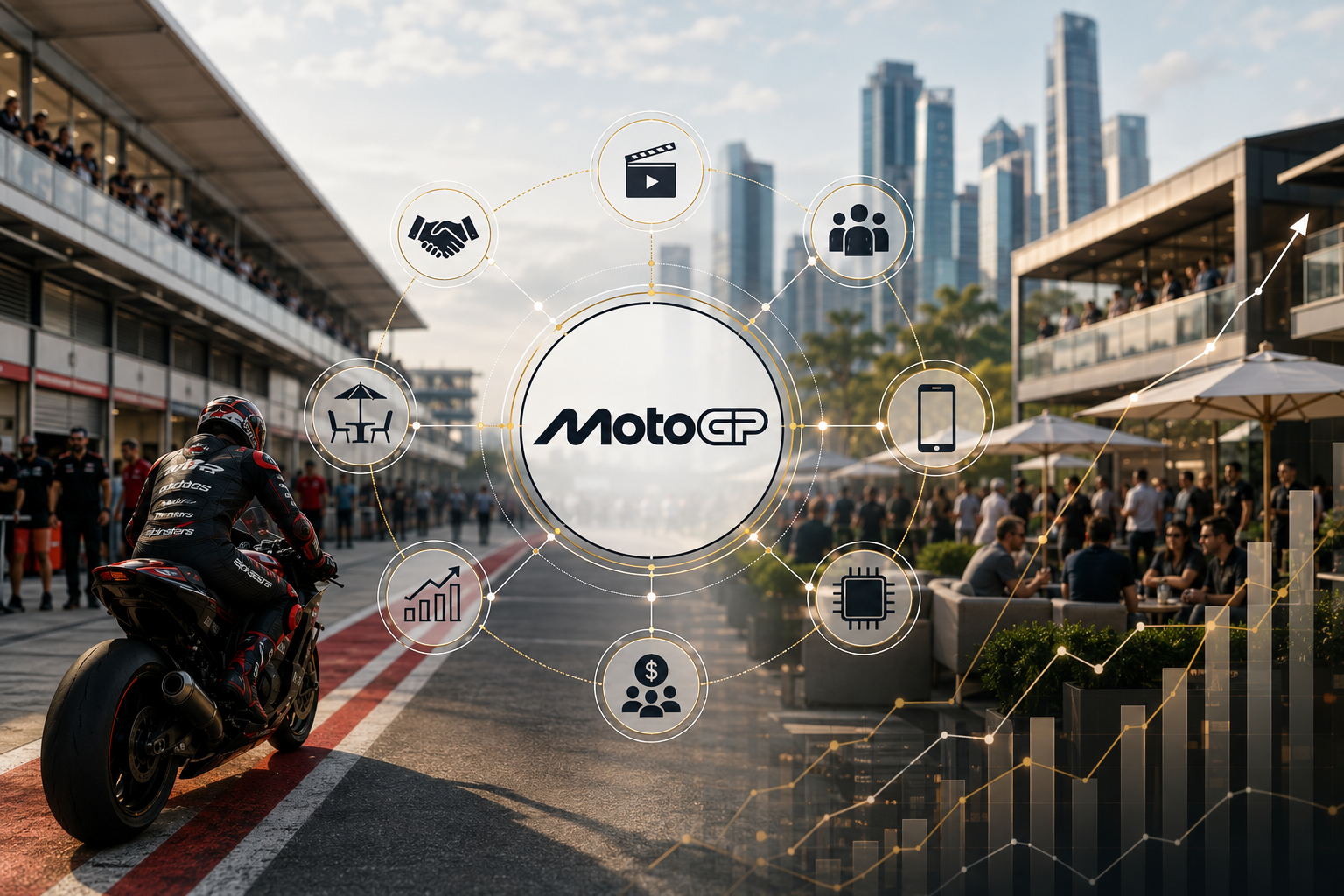
The word platform is used loosely in sports business. In the context of a MotoGP team, it has a precise meaning: a platform is an environment that allows multiple actors — fans, partners, media and businesses — to interact continuously rather than occasionally. It generates value not through a single product or event, but through the ecosystem that forms around it.
In a traditional model, the race weekend is the main value moment: sponsors receive exposure, teams compete, fans watch. In a platform model, value is created every day: content circulates constantly, partners communicate through the sport year-round, and fans interact rather than simply observe. The competition remains essential — but it becomes the centre of a much larger ecosystem, not the ecosystem itself.
The 365-Day Value Cycle
Understanding the platform model requires mapping what a team actually does — and can do — across the entire calendar year, not just during the season.
The competitive season remains the core. Race weekends generate the attention, the content, the drama and the media coverage that fuel everything else. Hospitality activations, sponsor visibility, rider narrative, team storytelling — all of these reach their highest intensity during the season. But in a platform model, they are not isolated events. They are chapters in a continuous story.
The off-season is where the platform model diverges most dramatically from the traditional one. For a racing team, the off-season is preparation — technical development, testing, contract negotiations. For a platform, the off-season is production. It is when content strategies are built, when community is cultivated, when partnerships are structured, when the team’s identity is developed and refined. A platform does not go quiet in November. It shifts register.
The year-round content engine is perhaps the most significant structural difference. A platform team produces content continuously — not press releases and race reports, but storytelling. Behind-the-scenes access, rider personality, team culture, technical narratives, historical content, community stories. This content serves multiple purposes simultaneously: it builds the fanbase, it provides activation value for sponsors, it generates media coverage in the absence of racing, and it deepens the emotional connection between the team and its audience.
The community dimension transforms the fanbase from an audience into a constituency. A platform team knows who its fans are, speaks to them consistently and builds structures — digital and physical — through which those fans can engage with the team beyond race weekends. Community is a commercial asset. A team with an engaged, loyal community attracts different partners, at different values, than a team with passive viewership.
The partnership ecosystem in a platform model is not a list of sponsors. It is a network of brands that have found genuine commercial value in the team’s world — through content, through community access, through hospitality, through co-created activations, through the association between their brand and the team’s identity. These partners are not buying forty weekends of logo visibility. They are buying year-round access to an ecosystem.
Where the Value Actually Lives
In the traditional model, a team’s commercial value is largely a function of its sporting results and its media exposure during races. In the platform model, value is distributed differently — and more resiliently.
Brand equity — the value of what the team represents, independently of results — becomes a primary asset. A team with a strong, distinctive identity attracts partners, fans and talent regardless of where it finishes. Brand equity accumulates over time and does not reset at the end of every season.
Content rights — the intellectual and commercial value of the stories, images, footage and narrative the team produces — become increasingly significant as the demand for behind-the-scenes and personality-driven content grows. A team that manages its content rights strategically is building an asset library with long-term commercial value.
Community access — the ability to connect partners with an engaged, defined audience — is a form of value that traditional sponsorship packages do not capture. Brands increasingly want not just visibility but access: to the team’s community, to its events, to the conversations happening around it.
Experience and hospitality — the ability to create meaningful, exclusive experiences for partners and their guests — extend the team’s commercial footprint beyond media exposure into relationship building and B2B value creation.
None of these sources of value exist only on race weekends. They are built continuously, across the entire year, through deliberate investment in the team’s identity, content and community.
The Figures the Platform Requires
A platform of this complexity does not run itself. It requires professional figures who do not yet exist in most MotoGP teams — or who exist only in embryonic form.
A Brand Manager who treats the team’s identity as a strategic asset, managing its coherence and evolution across every touchpoint throughout the year. An Activation Manager who ensures that commercial partnerships generate genuine, measurable value for partners — not through passive visibility but through active, creative engagement. A Narrative and Media Production Manager who manages the team’s storytelling across all formats, including the behind-the-scenes and documentary content that Liberty Media’s model will increasingly demand. An ESG and Community Manager who builds and manages the team’s relationship with its broader stakeholder environment — fans, local communities, sustainability commitments, social programmes — as integral parts of the platform’s value proposition.
These are not support roles. In a platform model, they are the engine of commercial value creation.
The Timing Question
The platform model is not a future possibility. It is already being built — by Liberty Media at the championship level, by equity investors who are acquiring teams with this model in mind, and by a small number of teams that have begun to invest in the capabilities it requires.
The teams that build this infrastructure now will have a structural commercial advantage over the next decade. Not because they will win more races, but because they will generate more value from every race — and between every race, and after every season, and before every season begins.
The competitive calendar gives every team the same number of weekends. The platform model is where the difference is made.