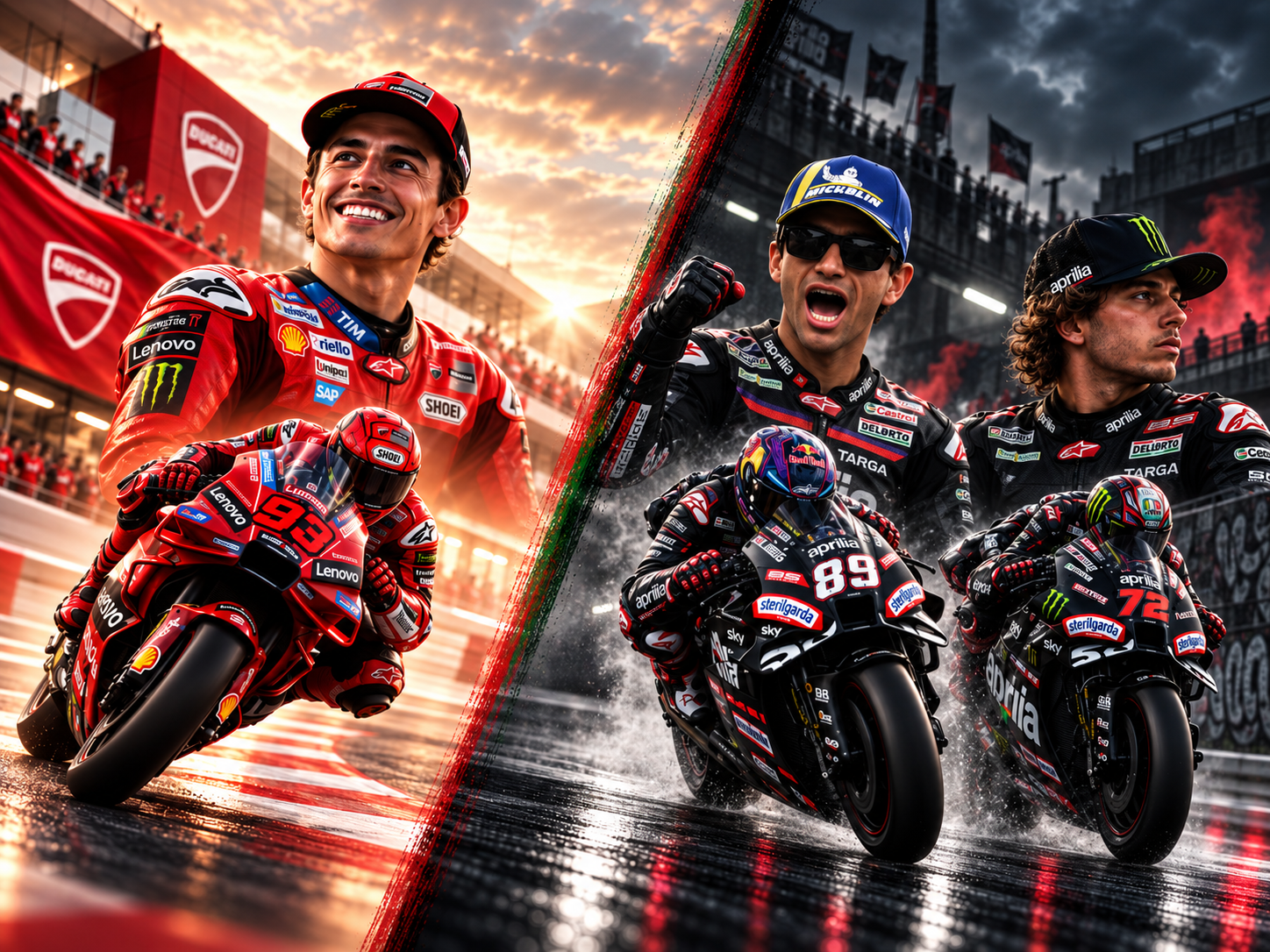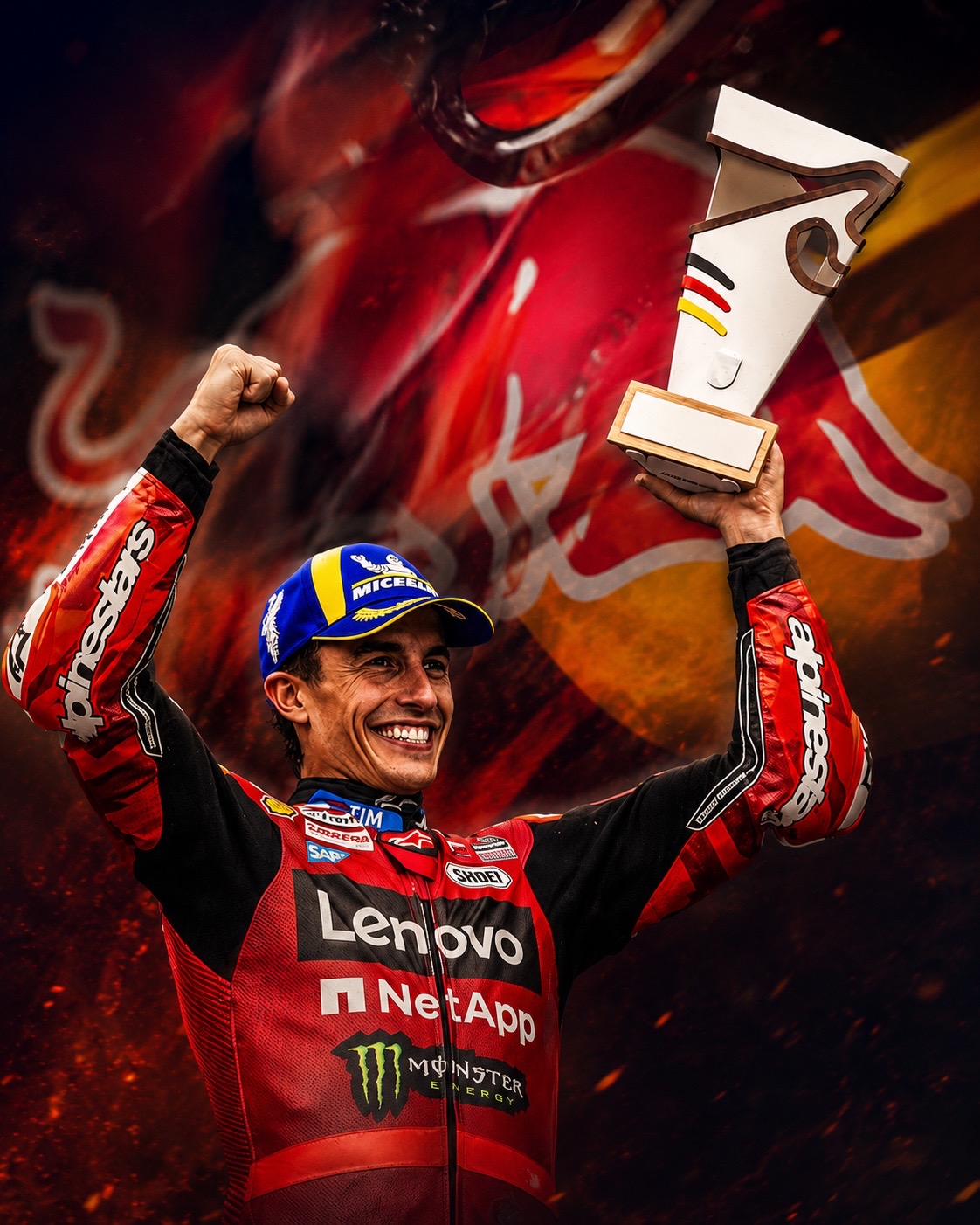
The next MotoGP round at Misano will be a home Grand Prix for the two Italian manufacturers currently setting the benchmark in the championship: Ducati and Aprilia.
Same country.
Same racing heritage.
Same home stage.
But two very different brand identities.
And that is exactly what makes the comparison so interesting from a commercial perspective.
Both manufacturers can draw from the same cultural territory.
Italian design.
Performance.
Emotion.
Craftsmanship.
Style.
Yet they increasingly seem to interpret those values in very different ways.
Ducati is moving further into a premium and aspirational environment.
Aprilia feels younger, more urban, more culturally fluid and potentially much closer to the language of contemporary entertainment.
Both are benefiting from strong sporting momentum.
But they are turning that attention into two very different stories.
Ducati: Italian Performance as Luxury
Ducati is clearly benefiting from one of the strongest sporting periods in its recent history.
Winning increases visibility.
Visibility increases desirability.
And sustained success gives a brand a powerful narrative to communicate.
But Ducati’s current commercial strength cannot be explained by results alone.
The brand work started long before this winning cycle.
For years, Ducati has progressively built an ecosystem around Italian design, craftsmanship, performance and exclusivity.
Its collaborations across luxury, fashion, watches and premium lifestyle categories are evidence of a brand that increasingly operates beyond motorcycles.
Sporting success is now amplifying something that was already there.
That distinction matters.
Winning can accelerate brand value.
But winning alone cannot create a strong identity from nothing.
Ducati had already built the foundations.
X2 and the Corporate Dimension
Within MotoGP, the X2 hospitality project is another interesting expression of this positioning.
The opportunity is not simply to sell hospitality seats.
It is to create an environment where premium experience, networking, partner activation and corporate relationships can coexist.
That opens a much wider commercial territory.
Luxury fashion.
Premium watches.
High-end travel.
Private banking.
Fine dining.
Automotive.
Corporate hospitality.
And potentially other elite sporting environments.
I would not be surprised to see Ducati increasingly explore cross-sport collaborations in areas such as golf or tennis.
Not necessarily through traditional sponsorship.
A private Ducati lounge around a Grand Slam.
A premium corporate experience linked to a major golf tournament.
A capsule collection connected to an elite sporting occasion.
A hospitality programme designed for partners and high-value customers.
The objective would not necessarily be reaching the biggest possible audience.
It would be reaching the right audience.
That is a very different commercial philosophy.
World Ducati Week and the Importance of Community
There is another important element in Ducati’s brand strategy.
Community.
Premium positioning creates aspiration.
But aspiration can also create distance.
A brand can become admired without necessarily feeling accessible.
Events such as World Ducati Week help solve that problem.
They create belonging.
Owners.
Fans.
Riders.
Partners.
Employees.
All become part of the same environment and the same story.
That is commercially powerful.
The brand becomes something people do not simply buy.
They join it.
Ducati’s ability to combine exclusivity with community is one of its strongest assets.
Luxury creates aspiration.
Community creates proximity.
And together they make the brand more resilient than sporting performance alone ever could.
Aprilia: Italian Performance as Contemporary Culture
Aprilia starts from the same national heritage but has the opportunity to interpret it in a very different way.
Its personality feels more immediate.
More youthful.
More irreverent.
More urban.
And potentially more naturally connected to creators, entertainment and digitally native audiences.
This does not mean moving away from performance.
Quite the opposite.
Sporting success is currently giving Aprilia the attention it needs to define this next phase.
The brand has moved from challenger status to being one of the central references of the championship.
That change in sporting perception matters.
Attention changes commercial value.
Success creates relevance.
Relevance creates desirability.
Desirability creates opportunity.
Monster as a Commercial Signal
The recent Monster Energy title sponsorship is an important signal in this process.
It suggests that Aprilia is becoming increasingly attractive as a commercial property.
A global brand making a title-level commitment is not simply buying logo placement.
It is making a judgement about the visibility, relevance and future potential of the platform.
And stylistically, Monster could fit very naturally with the commercial territory Aprilia has the opportunity to build.
Energy.
Creators.
Music.
Gaming.
Streetwear.
Action sports.
Digital entertainment.
Youth culture.
That does not mean Aprilia should simply become “the young brand”.
That would be too simplistic.
The opportunity is to build a cultural language that feels naturally younger because it comes from the personality of the brand itself.
That is a much stronger position.
Two Different Commercial Territories
This is where the Ducati-Aprilia comparison becomes especially valuable.
Both are Italian.
Both compete at the highest level of motorcycle racing.
Both can talk about performance.
Both can talk about passion.
Both can talk about design.
If they stop there, however, they become interchangeable.
The real opportunity is to interpret those same values differently.
For Ducati, Italian performance can mean prestige, craftsmanship, exclusivity and aspiration.
For Aprilia, Italian performance can mean energy, creativity, irreverence and contemporary culture.
Both narratives are credible.
Neither needs to copy the other.
In fact, they become stronger precisely because they are different.
The Non-Endemic Opportunity
This distinction could become increasingly valuable as MotoGP continues to attract more non-endemic brands.
The challenge will not simply be finding companies willing to enter the championship.
The real question will be:
Why should this specific brand belong with us?
For Ducati, a luxury fashion house can make sense.
A premium financial services brand can make sense.
A high-end travel company can make sense.
A tennis or golf activation can make sense.
For Aprilia, a creator platform can make sense.
A gaming company can make sense.
A streetwear label can make sense.
A music or entertainment brand can make sense.
A youth-oriented technology company can make sense.
This is where identity starts influencing sponsorship strategy before the deal is signed.
Not afterwards.
Sporting Performance Creates Attention. Identity Decides What Happens Next.
Ducati and Aprilia are currently in two interesting but different phases.
Ducati is using sporting success to amplify an identity and a commercial ecosystem that have been built over many years.
Aprilia is using sporting success to accelerate the recognition and definition of its own commercial territory.
Monster is already a sign that the market is responding.
The next question is what Aprilia chooses to build around that momentum.
Because sporting cycles change.
Today’s leader will not necessarily be tomorrow’s.
A brand cannot base its long-term commercial value only on results.
Performance creates attention.
Identity determines whether that attention becomes long-term value.
Identity Is What Prevents Homogenisation
And this is where the discussion goes beyond Ducati and Aprilia.
As MotoGP becomes more commercially sophisticated, there is a natural risk of homogenisation.
The same sponsor categories.
The same hospitality concepts.
The same content.
The same communication language.
Performance.
Innovation.
Passion.
Technology.
Excellence.
Every team and every manufacturer can use those words.
And if everyone tells the same story, eventually nobody owns it.
Identity is what prevents that.
A strong identity gives a brand a point of view that cannot simply be copied.
It influences the partnerships it signs.
The audiences it prioritises.
The content it creates.
The experiences it develops.
The industries it approaches.
The tone it uses.
And even the opportunities it decides not to pursue.
That is why identity should never be treated as a cosmetic branding exercise.
It is a strategic filter.
Ducati and Aprilia are interesting because they show how two brands can begin from the same cultural heritage and still build completely different commercial worlds.
Misano will put both of them on the same home stage.
Same country.
Same heritage.
Same championship.
But potentially two very different futures.
Italian heritage is not a positioning. It is raw material.
What matters is how each brand chooses to interpret it.
Because in an increasingly competitive commercial environment, the strongest brands will not be those trying to appeal to everyone.
They will be the ones capable of telling a story that only they can credibly tell.
Sporting performance creates attention.
Identity decides what that attention becomes.