Preview
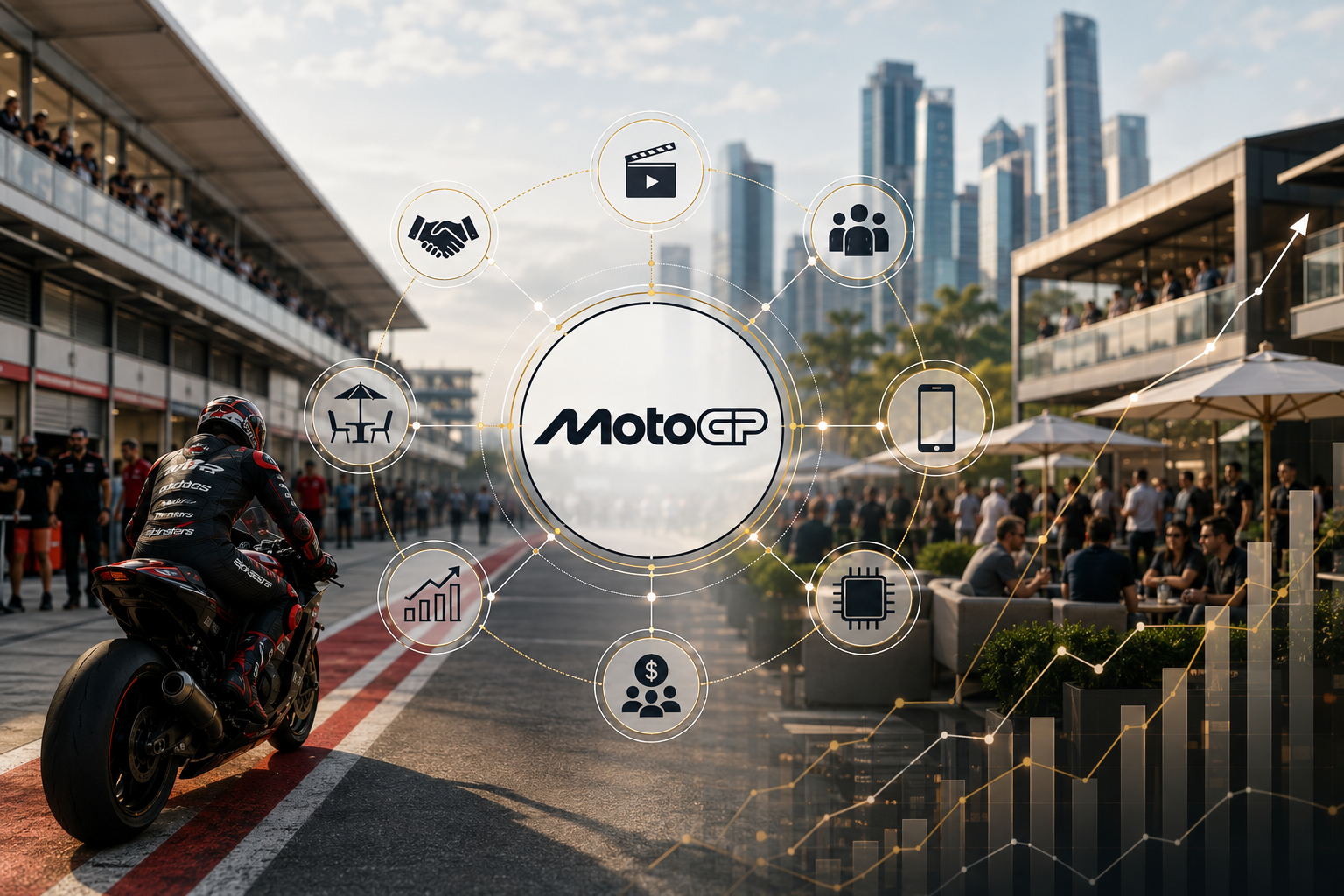
As Liberty Media takes control of MotoGP, one of the most critical negotiations concerns the distribution of revenues — particularly from media rights. The outcome could redefine the economic structure of the championship and bring it closer to models already established in Formula 1 and NASCAR.
The Core of the Negotiation
At the centre of current discussions between MotoGP teams, manufacturers and Liberty Media lies a fundamental question:
👉 how should the revenues be shared?
MotoGP’s business model has historically been different from Formula 1.
- Dorna (now MotoGP Sports Entertainment Group) owns and centralises all commercial and TV rights
- Teams receive participation payments rather than a large share of central revenues
Media rights are the largest revenue stream in MotoGP, accounting for roughly 40–45% of total income
This makes the negotiation over TV rights distribution particularly important.
What Teams Are Asking For
With Liberty Media now involved, teams and manufacturers are pushing for:
- higher financial participation
- greater governance influence
- a structure similar to Formula 1’s Concorde Agreement
In fact, manufacturers have explicitly demanded:
- more money
- more decision-making power
- a formalised agreement inspired by F1
This is a key shift.
MotoGP teams are no longer positioning themselves as participants.
They are positioning themselves as stakeholders.
The Formula 1 Benchmark
Formula 1 provides the clearest reference.
Under the Concorde Agreement:
- teams collectively receive a significant share of revenues
- TV rights are negotiated centrally
- prize money is distributed based on performance and historical status
Historically, Formula One Management (FOM) retained ~49% of TV revenues, with the rest distributed across stakeholders
More importantly, F1 has evolved into a model where:
👉 teams are directly aligned with the financial growth of the championship
This alignment is one of the reasons why:
- teams invest more
- valuations have increased
- new investors have entered the sport
Liberty Media’s Position
Liberty Media’s challenge is balancing two objectives:
- maintaining central control of the product
- increasing team incentives to grow the championship
Early signals suggest that MotoGP will not fully replicate Formula 1.
Reports indicate that Liberty and Dorna are likely to:
- maintain a fixed-fee participation model
- gradually increase financial incentives
- avoid excessive disparities between teams
This suggests a hybrid system, rather than a full F1-style structure.
The NASCAR Comparison
A useful comparison comes from NASCAR.
NASCAR operates under a different model:
- teams receive revenue shares from media rights
- prize money is linked to performance
- the charter system guarantees entry and revenue participation
The charter system effectively turns teams into:
👉 semi-franchise assets
This has several effects:
- stabilises team finances
- increases team valuations
- creates long-term commercial security
However, it also introduces:
- less competitive fluidity
- more structural rigidity
Three Models, Three Logics
At this point, we can identify three distinct systems:
MotoGP (historical model)
- centralised revenues
- fixed participation payments
- limited team control
Formula 1
- revenue sharing
- performance-based distribution
- strong team bargaining power
NASCAR
- franchise-like system
- guaranteed participation
- asset-driven model
MotoGP is now negotiating its position between these three.
What Could Change
The most realistic outcome is not a direct copy of any model, but a gradual evolution:
- increased revenue share for teams
- stronger commercial alignment
- more structured agreements (MotoGP equivalent of Concorde)
- potential reduction of differences between factory and satellite teams
This would fundamentally change how teams operate financially.
Why This Matters
This negotiation is not just about money.
It is about:
- incentives
- investment
- long-term growth
If teams participate more directly in revenue growth:
- they become more commercially active
- sponsorship becomes more integrated
- valuations increase
In other words:
👉 the economic behaviour of teams changes.
Conclusion
MotoGP is entering a critical phase.
The negotiation between teams and Liberty Media will determine not only how revenues are distributed, but how the entire championship operates as a business.
Formula 1 shows what happens when teams are financially aligned with growth.
NASCAR shows what happens when teams become assets.
MotoGP now has the opportunity to define its own model.
And the decisions taken in these negotiations will shape the next decade of the championship.